



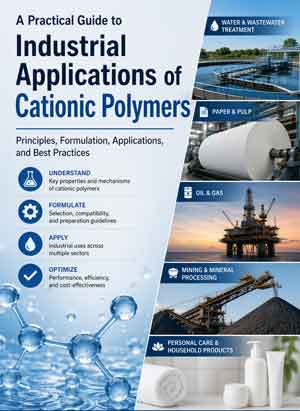
A Practical Guide to Industrial Applications of Cationic Polymers
If you've ever worked in water treatment, papermaking, or oilfield chemicals, you're surely familiar with the term “cationic polymer”. However, many people's understanding of it may still be limited to the idea of a “positively charged chemical”. In fact, the role of these materials in modern industry is far more versatile than you might imagine—they can act like “glue” to bind tiny particles together, or like “bridges” to alter the flow characteristics of liquids.
This article is not a dry theoretical discussion; rather, it addresses real-world industrial challenges to help you accurately understand what cationic polymers are, how to select them, and the details that are often overlooked during their application.
I. Positively Charged “Microscopic Grippers”
The key to cationic polymers lies in the positive charge they carry. In nature and industrial processes, many impurities that need to be removed or recovered—such as suspended sludge particles and fine fibers in paper—carry a negative charge. Positive and negative charges attract each other, and cationic polymers act like precision “magnets”, actively capturing these target substances.
Its practical advantages are reflected in the following three most direct aspects:
- Turning Turbidity into Clarity: In wastewater treatment, it rapidly neutralizes the charges on particle surfaces, causing tiny particles that would normally repel each other to aggregate into large flocs, which can then be easily separated through sedimentation or dissolved air flotation.
- Suitable for a wide range of environments: The vast majority of cationic polymers are water-soluble, allowing them to be conveniently added in liquid form and uniformly dispersed throughout the treatment system without the need for complex dissolution equipment.
- Versatile Applications: By adjusting the dosage and molecular structure, the same cationic polymer can be used as a sludge dewatering conditioner, a dry strength enhancer for paper, and even to stabilize wellbores in drilling fluids.
II. What Are the Differences Between the Main Types Available on the Market?
Choosing the wrong product type is the most common mistake in industrial applications. To avoid this problem, you first need to have a clear understanding of how products are categorized in the market.
Overview of Common Varieties
- Polyquats: These products have a high charge density and a very broad pH range. “Polyquat-7” or “Polyquat-10” found in shampoos and conditioners belong to this category; in industrial applications, they are also commonly used as biocides or antistatic agents for textiles.
- Cationic polyacrylamide (C-PAM): This is the “workhorse” in the fields of water treatment and sludge dewatering. Its advantage lies in its ability to achieve very high molecular weights, which, through a “cross-linking” mechanism, connects a large number of fine particles into strong, large flocs, making it highly suitable for sedimentation and filter press applications.
How is it different from the anionic type?
Many people get confused between “cations” and “anions”. Just remember this simple rule: Check the charge of the substance you're dealing with.
- If the system contains negatively charged organic matter, bacterial flocs, or fine sludge, cationic types are the preferred choice;
- The anionic type should only be considered if the target is a positively charged metal hydroxide or a specific mineral.
If the wrong choice is made, not only will there be no treatment effect, but the system may actually become even more dispersed due to electrostatic repulsion—a classic case of “throwing good money after bad”.
III. In which industries does it truly play a leading role?
1. Water Treatment and Sludge Dewatering
At municipal wastewater treatment plants and industrial wastewater treatment facilities, cationic polyacrylamide is practically a “standard component”. It serves two primary functions: first, to aid in the formation of flocs in the coagulation tank; and second, during the sludge dewatering stage, to break down the colloidal structure of the sludge, release the water trapped within it, and ensure that the sludge discharged from plate-and-frame filter presses or centrifuges is drier and processed more efficiently.
2. Oil and Gas Field Extraction
During drilling and fracturing operations, cationic additives can act as inhibitors to prevent wellbore collapse caused by the swelling of clay minerals when exposed to water. At the same time, they also help separate oil-water emulsions during produced water treatment, serving a dual supportive role.
3. Paper and Pulp
In the papermaking process, cationic polymers are typically used as “retention and filtration aids”. Simply put, their function is to ensure that expensive fine fibers and fillers (such as calcium carbonate) are retained on the paper sheet rather than being lost in the white water. This not only reduces raw material costs but also improves the paper's uniformity and strength.
4. Emerging Application Areas
In agriculture, some are beginning to experiment with using cationic polymers to coat fertilizers or seeds to achieve a controlled-release effect; in the biomedical field, they are also being explored as drug delivery carriers. Although these applications have not yet developed into large-scale markets, their prospects are worth watching.
IV. Product Selection Is Not About Specifications, but About “Compatibility”
When selecting a cationic polymer, don't just look at a few numbers in the product specifications; the key is whether it is compatible with your system.
Three Key Metrics You Must Understand
- Charge density (cationicity): This determines the strength of the “adsorption capacity.” For sludge with high concentrations and high organic content, products with high charge density are typically required for effective neutralization; whereas for inorganic wastewater with simple compositions, a moderate charge density may be sufficient.
- Molecular weight: A higher molecular weight results in longer chains and stronger cross-linking ability, forming larger but more brittle flocs; a lower molecular weight provides greater penetration and is more suitable for conditioning prior to dewatering. The specific choice depends on whether the downstream separation equipment is a centrifuge or a belt filter press.
- Effect of pH: pH alters the extension state and charge intensity of polymer chains. If the operating pH is too low (strongly acidic) or too high (strongly alkaline), be sure to confirm the product's stability under these conditions with the supplier.
Here's a real-life case study that might be worth considering:
A textile dyeing wastewater treatment plant had previously been using imported neutral products, which delivered acceptable results but came with persistently high costs. Based on the charge characteristics of the dyes in the wastewater, we recommended switching to a domestically produced cationic polymer with high charge density and medium-to-low molecular weight. After adjusting the dosing method, flocculation efficiency improved by approximately 15%, dissolution was faster, and preparation time was reduced by one-third. This demonstrates that selecting the right product is more cost-effective than blindly pursuing “high-end” options.
V. Environmental Protection and Safety: These Red Lines Must Not Be Crossed
Objectively speaking, cationic polymers themselves are not highly toxic substances, but we must take their degradation products and environmental fate into account.
- Confirmed Biodegradability: Not all cationic polymers are readily biodegradable. For applications involving direct discharge into natural water bodies or use in agricultural irrigation, it is recommended to prioritize products explicitly labeled as “readily biodegradable” or “green” grades, and to request relevant ecotoxicological data.
- Safety precautions during operations are essential: Whether handling solid powders or liquids, avoid inhaling dust or skin contact during operations. On-site personnel must wear dust masks, safety goggles, and rubber gloves. Do not lock the MSDS (Material Safety Data Sheet) in a cabinet; instead, post it on the wall of the preparation room and train employees to understand its contents.
VI. What recent developments are worth noting?
This industry has made significant progress in recent years. In the past, cationic products often faced the dilemma of being unable to achieve both “high charge density” and “high solubility” simultaneously. However, thanks to new polymerization processes, new products have emerged on the market that dissolve rapidly at room temperature and form more compact flocs. In addition, some suppliers have begun offering “customized blending” services, pre-mixing cationic polymers with other additives based on the user's water and sludge characteristics, resulting in more stable and hassle-free on-site application.
VII. Frequently Asked Questions
Answer: Cations carry a positive charge and are specifically used to treat various negatively charged “contaminants”; anions carry a negative charge and are used to treat positively charged systems. The applications of the two almost never overlap.
Answer: This is quite common. The stirring speed in a laboratory beaker is completely different from the pumping conditions and shear forces in the pipeline at the site. When large-scale equipment is in operation, the flocs may be broken up. When conducting pilot-scale tests, it is recommended to focus on the flocs “shear recovery capacity,” which is more important than simply observing the settling velocity.
Answer: Yes. Some manufacturers have introduced cationic derivatives based on naturally modified starch or chitosan, which have a lower carbon footprint and produce safer degradation products; however, they are typically more expensive, and their treatment effectiveness is more sensitive to fluctuations in water quality.
Answer: Keep it dry, keep it dry, keep it dry. Whether it's a solid powder or an emulsion, moisture can cause clumping or hydrolysis, rendering the product ineffective. Once opened, it's best to use it up as soon as possible.
Conclusion
Cationic polymers are not a “one-size-fits-all” solution, but rather a tool that must be carefully selected based on specific operating conditions. Their value lies in your understanding of water quality characteristics, your familiarity with the equipment, and in-depth communication with your supplier. We hope this guide will help you avoid unnecessary detours and give you greater confidence in future applications and product selection. If you're ever unsure, the safest approach is always to: conduct small-scale tests first, followed by on-site pilot testing, and only then proceed with bulk procurement.